Friday, 20 September 2013

Racial Profiling: The Case of Trayvon Martin


Public Lecture: Racial Profiling: The Case of Trayvon Martin - Prof. Charles Lumpkins
Date: Sunday 20th October 2013
Venue: UEA London (Room 5.18)
Time: 11 am – 1 am – Talk followed by Q&A.
Cost: Free


Description

Prof. Charles Lumpkins (Penn State University) will be discussing the recent trial and acquittal of George Zimmerman for the murder of the African American teenager Trayvon Martin. He will analyse the racial significance of the case in the US as well as the continued problem of racial profiling in the United States and the United Kingdom. Prof. Lumpkins is lecturer in the School of Labor and Employment Relations at Pennsylvania State University. His research focuses on the history of African Americans with particular interests relating to the history of social and political movements, the history of the working-class. He 2008 he published American Pogrom: The East St. Louis Race Riot and Black Politics with Ohio University Press.

The talk will take place on Sunday 20th October at UEA London, 102 Middlesex Street, London E1 7EZ.

Please email n.grant@uea.ac.uk to register.


Wednesday, 18 September 2013

Black History Month 2013


The School of American Studies is running a number of free public events to coincide with Black History Month. Led by UEA staff and postgraduates, all of these talks are completely free and will be held at the Norwich Millennium Library as well as Fusion at the Forum (see event listings below). They will cover a range of subjects from Abraham Lincoln and the Emancipation Proclamation to the Anti-Apartheid movement in Norwich. If you'd like any more information about any of these events, or AMS's involvement in Black History Month as a whole, please email Dr. Nick Grant (n.grant@uea.ac.uk).

Full list of events:

Title: ‘“Forever Free?” Lincoln’s Emancipation Proclamation and the Real Meaning of Freedom’ – Dr. Becky Fraser (UEA)
Venue: Norwich Millennium Library
Date: 1st October
Time: 6-7:30 pm
Nature of Event: Talk
Cost: Free

In the 150th year anniversary of President Abraham Lincoln’s Emancipation Proclamation, freeing all enslaved peoples in the Confederate States of America, this lecture will consider the very complex and complicated dimensions of freedom for the nearly four million enslaved peoples the Proclamation applied to. In addition it will question whether Lincoln can be, and indeed should be, hailed as the Great Emancipator, given the limits of the actual declaration and its historical legacies.


Title: ‘Collection and Commemoration: Slavery in Sight and Memory’ – Nicole Willson (UEA)
Venue: Norwich Millennium Library
Date: 10th October
Time: 12-1:30 pm
Nature of Event: Talk
Cost: Free

This talk looks at visual representations of slavery in museums and memorial sites across the United Kingdom. It considers the unseen and the unsaid in such commemorative spaces and addresses the idea that the practice of memorialisation is twinned with forgetting. Contemplating the evolution of museological practice from the birth of the modern museum in the eighteenth century, it also ponders whether such practices can offer restitution and for whom, if they do, this restitution serves. 


Title: ‘Warrior Marks: Alice Walker’s Writing’ – Dr. Rebecca Tillett (UEA)
Venue: Norwich Millennium Library
Date: 15th October
Time: 6-7:30 pm
Nature of Event: Talk
Cost: Free

The controversy surrounding both the publication of the Pulitzer Prize winning The Color Purple (1982) and Steven Spielberg’s 1985 film adaptation focused on claims that Walker had refused a full focus on racism in order to discuss African American women’s experiences of sexism in the 1930s American South. Moreover, Walker’s depiction of often fraught relationships and power dynamics between African American men and women, and within black families was condemned as fuelling racist stereotypes. Taking The Color Purple as a starting point, this lecture will assess the relationship between Walker’s writing and her own  passionate and ongoing commitment to political commentary and activism.


Title: ‘The Local Dimension of the Anti-Apartheid Movement: the Case of Norfolk’ – Dr. Nick Grant (UEA)
Venue: Norwich Millennium Library
Date: 16th October
Time: 6-7:30 pm
Nature of Event: Talk
Cost: Free

This talk will address the materials that make up the Global Anti-Apartheid Movement in Norwich exhibition. It will explore the contributions of local businesses, politicians and students in Norwich to the international consumer boycott of apartheid South Africa. 


Title: Racial Profiling: The Case of Trayvon Martin – Prof. Charles Lumpkins (Penn State University)
Date: 24th October 2013
Nature of event: Talk
Venue: Fusion, the Forum, Norwich
Time: 6–7:30 pm – Talk followed by Q&A.
Cost: Free
  
Prof. Charles Lumpkins will discuss the recent trial and acquittal of George Zimmerman for the murder of the African American teenager Trayvon Martin. He will analyse the racial significance of the case in the US as well as the continued problem of racial profiling in the United States and the United Kingdom. Prof. Lumpkins is lecturer in the School of Labor and Employment Relations at Pennsylvania State University. His research focuses on the history of African Americans with particular interests relating to the history of social and political movements, the history of the working-class. He 2008 he published American Pogrom: The East St. Louis Race Riot and Black Politics with Ohio University Press.


Thursday, 12 September 2013

1963: A Turning Point in the Civil Rights Movement


On the 14th October AMS’s Dr. Malcolm McLaughlin and Dr. Nicholas Grant will be at the British Library to discuss the significance of 1963 for the history of the Civil Rights movement in the United States and for racial politics around the world.

1963 looms in American memory as a year that changed the course of the nation's history, while shaping how the United States was perceived around the world. When considering the Civil Rights movement, it is so often the events of that year that come to mind: iconic images of police officers setting dogs and turning fire hoses on peaceful marchers in Birmingham, Alabama, in full view of the press and television cameras; Martin Luther King's ‘I have a dream’ speech at the March on Washington on 28 August. 

Dr. McLaughlin will focus on the March on Washington and will ask what we can learn about the Civil Rights movement, its ambitions, and its achievements, by thinking about controversies surrounding the march at the time, and how it has entered American folklore since. Dr. Grant will then open up some new perspectives on the civil rights movement by tracing political connections between black activists in the United States and South Africa, and showing how the Birmingham campaign and March on Washington travelled overseas, shaping racial politics around the world.


This event is co-sponsored by the University of East Anglia and the Eccles Centre at the British Library.


You can book a place for the talk here.


Wednesday, 14 August 2013

Nicole Willson at the British Museum


In September, current AMS Postgraduate student Nicole Willson will be giving what promises to be a fascinating 'Gallery Talk' at the British Museum in London. She will be speaking on 'Curiosity, collection and memory: thinking about slavery and display in the Age of Enlightenment' - a subject that is close to her doctoral dissertation on the literature, history and culture of the black diaspora. Guiding listeners through the Enlightenment Gallery (Room 1) at the museum, Nicole will discuss the intersections between discovery, collection and slavery.


From Hans Sloane's encounters with enslaved people and plantation labour in his voyages to Jamaica in the early eighteenth century, to the advancement of the abolitionist movement at the century's end. this talk will consider how the Enlightenment, and the museum as its cultural emblem, struggled to negotiate the problem of slavery.

The talk will take place at 1.15pm on Friday 20th September. Click here for more information. You can follow Nicole on twitter here.


Tuesday, 2 July 2013

The Battle of Gettysburg at 150

Seven score and ten years ago today, the Battle of Gettsyburg - perhaps the most pivotal moment in the American Civil War - was being fought in Pennsylvania. You can see how Harper's Weekly reported things at the time here, and the New York Times Disunion blog has a great assessment of "What Gettysburg Proved", here. Those two links are the tiny tip of a very large iceberg of online commentary and resources. So below, a selection of links that have caught our eye on Twitter. Please feel free to share your own suggestions for further reading in the comments.

A Busy Week at the Supreme Court (Part III): Same Sex Marriage

 
Having addressed race conscious university admissions on Monday and the Voting Rights Act on Tuesday last week (see previous posts here and here), Emma Long analyses the Supreme Court's decision made on Wednesday June 26, the final day of its term, in the issue of same sex marriage.  The two cases raised rather different issues and were treated quite differently by the Court: 

United States v. Windsor

The Case
US v. Windsor involved a challenge to Section 3 of the Defense of Marriage Act, enacted in 1996, which defines marriage as between one man and one woman.  Under the law, same sex couples who are legally married under the laws of their state were denied access to federal benefits and protections accorded to opposite sex couples.  The challenge was brought by Edith Windsor who, upon the death of her wife, Thea Spyer, received a bill for estate taxes totalling more than $360,000, a bill she would not have received had she been married to a man.  DOMA opponents, including Bill Clinton who as president signed it into law, argued the law discriminated against individuals on the basis of their sexuality.  Supporters of the law worried about what the striking down of DOMA would mean for the nature of families and the sanctity of marriage.

Edith Windsor outside the Supreme Court
The Court
In another 5:4 decision, this written by Justice Anthony Kennedy, the Court struck down Section 3 of DOMA.  The majority did so on two grounds: the power of the states and equal protection.  States have long-standing authority to pass laws which govern domestic relations, the Court argued, and this includes the right to determine what does and does not constitute “marriage” within their borders.  DOMA trampled on that authority by seeking to impose a federal definition of marriage in certain circumstances.  This harm was compounded, the majority argued, by the fact that DOMA violates the Fifth Amendment’s guarantee of equal protection.  Kennedy wrote: “When New York adopted a law to permit same-sex marriage, it sought to eliminate inequality; but DOMA frustrates that objective ... DOMA writes inequality into the entire United States Code.”  In a series of emotive passages, Kennedy’s opinion argued that DOMA “impose[s] inequality,” “demeans” same sex couples by determining their relationships as “second-tier marriage,” “humiliates tens of thousands of children” of same sex couples, and “imposes a disability on a class by refusing to acknowledge a status the State finds to be dignified and proper.”  The combination of the infringement of the power of the state and the unequal treatment of same sex couples was, for five Justices, sufficient to strike down Section 3 of DOMA as unconstitutional.

Three dissents were filed by the four Justices in the minority.  Three Justices (Chief Justice Roberts and Justices Scalia and Thomas) argued that the Court did not even have the right to hear the case.  Because the Obama Administration had refused to defend the law, they argued, and because Windsor had won her case in the lower courts, there was no “controversy” here to be decided.  Deciding the case was, therefore, a major expansion of the power of the Court that was not justified by any provision of the Constitution.  Coming from Justices on the Court’s conservative wing, from whom expansion of power claims are frequent, this was not surprising.  However, coming the day after the Court’s decision in Shelby County v. Holder (striking down key provisions of the Voting Rights Act), in which Justice Ginsburg for the Court’s liberals accused the majority of extending the Court’s power by denying the will of Congress, Windsor shows that such arguments can be made by both sides when necessary.

On the substantive issues raised by the case the dissenters agreed: the Constitution does not speak to the issue of marriage and therefore can neither support or undermine the right to same sex marriage.  Because the Constitution is silent, properly elected legislative majorities may decide either for or against.  Congress chose to support opposite sex marriage in DOMA which, the dissenters argued, was perfectly legitimate under the Constitution.  For Justice Alito, asking the Court to protect same sex marriage was asking it to protect “a very new right,” one where the consequences have yet to be seen (and thus, implicitly, viewing same sex marriage as somehow different from opposite sex marriage).  Justice Scalia employed sharp and pointed language to argue both that the government may “enforce traditional moral and sexual” norms and that, contrary to the majority’s claims of discrimination, there are “many perfectly valid – indeed, downright boring – justifying rationales for this legislation”.


Hollingsworth v. Perry

Gay rights activists outside the Supreme Court
The Case
Hollingsworth v. Perry came from a challenge to a California initiative, Proposition 8, which banned same sex marriage in the state.  Prop.8 was passed, by public vote, in response to a California Supreme Court decision which held that limiting marriage to opposite sex couples violated the state constitution (thus opening the way for same sex marriage in the state).  As the case made its way through the lower courts, however, the state government refused to defend the law.  In order to bring a case in court there must be a live controversy: without anyone to defend Prop.8 there was the chance that the case would be dropped.  Individuals who had been instrumental in the campaign for Prop.8 intervened in order to defend the law.  As argued before the US Supreme Court in March there were thus two issues for consideration: the broader issue of whether California, having once permitted same sex marriage, could then remove that right, and the narrower, technical issue of whether Prop.8’s supporters even had the right to defend it in court (a requirement known in legal terms as “standing”).  The outcome of the case had the potential for far broader consequences than US v. Windsor: some commentators had hoped that the Court might use this case to strike down all restrictions on same sex marriage.  Given the Court’s precedents this was undoubtedly overly optimistic thinking, but there was a chance that the Court would at least decide the status of same sex marriage in California which might then open up possibilities in other states.

The Court
In the end, the Court ducked the broader issue in favour of deciding the case on the narrow, technical grounds.  The proponents of Prop.8 had no standing to bring their challenge, according to the 5:4 majority; if the state chooses not to defend a law, private parties cannot simply stand in its stead.  As a result, the appeals to both the lower court of appeals and the Supreme Court were held invalid and the case was returned to the lower courts.
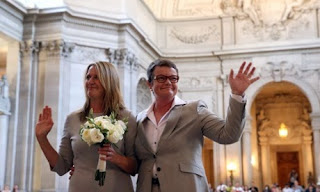
Sandy Stier and Kris Perry wave after they were married at San Francisco city hall.

The Significance
The practical implications of both Windsor and Hollingsworth are significant but, in some ways, rather limited.  With the demise of Section 3 of DOMA, same sex couples whose marriages are recognised in their home states will now be eligible for the same federal benefits and protections as opposite sex couples.  For those involved the financial and security impact may well be significant (as, for example, the first granting of a permanent residency visa to the Bulgarian husband of a Florida man on Friday afternoon or Edith Windsor receiving a refund of the estate tax she paid).  As a matter of law, however, the impact is less major, applying only to the 1000 or so federal laws governed by DOMA.

And despite Justice Scalia’s warnings in dissent in Windsor that this case will ultimately lead to a broad requirement that all states permit same sex marriage, the majority stated this was not the case, holding the ruling applied only to those states which already permit same sex marriage.  The Court’s decision did not challenge Section 2 of DOMA which gives states the right to refuse to recognise same sex marriages performed in other states and clearly made no explicit statement about whether states should permit same sex marriage under their own laws.  Thus, couples who marry in one state and then move to another may still run into difficulties under this rationale. 

This is reinforced by the Court’s handling of Hollingsworth.  Many had urged the Court to use the case to require states to recognise same sex marriage, or at least to make a strong statement in its favour.  Deciding the case on narrow, technical grounds, without addressing the substantive issues, implies that the Court has gone as far as it is currently prepared to with its ruling on DOMA.  In effect, both Windsor and Hollingsworth ensure that, for now, the issue of same sex marriage remains a debate to be had at state level. 

If subsequent events in California are anything to go by, those debates will continue apace.  Following the Court’s ruling on Wednesday, the Ninth Circuit lifted the ban on same sex marriage on Friday.  Several couples, including those involved in Hollingsworth, married Friday afternoon.  On Saturday Prop.8 proponents appealed to the Supreme Court to ban such marriages until at least the deadline for appeals to Court rulings had passed.  On Sunday Justice Kennedy refused that appeal, meaning same sex marriage remains, at least for now, legal in California.

But the impact of these cases goes well beyond the narrow legal principles established.  As the majority and dissenters in Windsor noted, same sex marriage is an issue of much current debate and the astonishing growth in public support for same sex marriage in the US will ensure that continues.  But now it will continue with at least one Supreme Court precedent that, in its language, makes some very strong statements about the value and validity of same sex marriage.  This in a nation where state laws making it a “crime for two persons of the same sex to engage in certain intimate sexual conduct” were only struck down in 2003 (notably enough, exactly ten years to the day before Windsor and in an opinion also written by Justice Kennedy – see Lawrence v. Texas).  And where, as recently as 1986, the Supreme Court could characterise a challenge to one such law as a claim to a “constitutional right of homosexuals to engage in acts of sodomy” (Bowers v. Hardwick).  In this light, the Court’s decisions in Windsor and Hollingsworth are quite remarkable and speak volumes about the impact of the campaign for gay rights in the United States.  The debates will continue, but in the push forward it is worth taking a moment to consider just how far things have already changed.
Monday, 1 July 2013

A Busy Week at the Supreme Court (Part II): The 1965 Voting Rights Act

 
Continuing her look at the cases handed down by the US Supreme Court this week, Emma Long turns her attention to Shelby County v. Holder, decided last week, the day after Fisher v. Texas (see previous post).

The Case
Shelby Co. v. Holder has garnered relatively little attention in the UK media but has been hugely controversial in the US.  The case involved a challenge to key sections of the 1965 Voting Rights Act, a law widely regarded as one of the crowning achievements of the movement for civil rights in the US in the 1960s.  The challenge focussed on the “preclearance requirement” which requires that certain voting districts held to have a history of racial discrimination in voting must obtain advance permission to change any voting regulations, from moving a polling station to altering the boundaries of voting districts.  The requirement was drawn up in response to tactics used to discriminate against voters which made it almost impossible for individuals to bring successful legal challenges.  Under the law, the burden was on voting districts to show that a proposed change would not result in a discriminatory effect on minority voters.  Most would agree that the law has been remarkably successful in meeting its objectives and reducing discrimination in voting.  But here lies the crux of the argument.  Supporters of the law argued that while there has been progress there is still a clear need for protection for minority voters in certain areas of the country. This was recognised by Congress, they argued, when the key provisions of the Voting Rights Act were renewed by Congress in 2006 with votes of 390:33 in the House and 98:0 in the Senate.  Opponents, meanwhile, argued that the provisions were outdated, that the election of President Obama indicates that any historic discrimination has been overcome, and that the law’s very success now means it is unnecessary.

The Court
The Supreme Court, with a narrow 5:4 majority, struck down the preclearance requirement as it currently operates.  In doing so the majority made two major arguments.  The first was that the determination of which voting districts were required to obtain preclearance no longer reflected the current experience of voting discrimination.  Repeatedly the majority opinion, written by Chief Justice John Roberts, argued that in 2006 Congress had not changed the formula for which states were covered by the Act despite the fact that “the conditions that originally justified these measures no longer characterize voting in the covered jurisdictions.”  For Court watchers this is not surprising.  Four years ago the Court warned Congress that the law was vulnerable on these grounds, arguing that Congress’ 2006 renewal of the Act had not looked closely enough at the situation in covered districts (a warning Roberts repeatedly returned to in his opinion).  Little had changed on the Court in the interim to suggest the outcome would be different and Congress has proved unwilling or unable to revisit the issue of preclearance. 

The majority also looked to voting patterns to suggest that the Voting Rights Act had achieved its aims.  Voter registration and turnout in most of the covered voting districts showed only limited differences between black and white voters, they argued, and “minority candidates hold office at unprecedented levels”.  Equally, they noted, in some cases minority voter registration and turnout is higher in covered districts than in uncovered ones, reinforcing the argument that the Voting Rights Act now unfairly penalises voting districts for past, not recent or current, offences.

The second major argument made by the majority emphasised the federalism element of the case: the Voting Rights Act treats states differently.  “Not only do States retain sovereignty under the Constitution, there is also a fundamental principle of equal sovereignty among the States,” wrote Roberts, a right violated by the Act.  Again, this concern with the rights of states is not surprising to Court watchers: the theme has been a significant part of many key cases in recent years.  Where the majority and the dissent differ is over the significance of this differential treatment.  For the dissenters, the evidence amassed by Congress in 2006 more than justified continuation of the restrictions on covered states.  For the majority, however, such a burden on the rights of states requires a clear, precise relationship between the methods used and the aims to be achieved: because the provisions were outdated this relationship no longer existed and the burden could no longer be justified.

The strength of the dissenters’ feelings in this case was reflected in Justice Ruth Bader Ginsburg, the dissent’s author, reading sections of the opinion from the bench.  The dissent rested on two key arguments.  First, Congress took a considerable amount of time and effort to investigate the situation in the US when it reauthorized the Act in 2006: since Congress determined there was a need for the provisions to continue, it was not the job of the Court to determine otherwise.  The majority, therefore, were substituting their judgment for that of Congress, based on far less evidence: “the Court’s opinion can hardly be described as an exemplar of restrained and moderate decisionmaking.  Quite the opposite.  Hubris is a fit word for today’s demolition of the VRA,” blasted Ginsburg.

Second, the evidence amassed by Congress revealed not only the achievements of the Act but a continuation of discriminatory voting practices.  In a lengthy section, Ginsburg recounted examples of activities from relatively recently that had been prevented by the Act to reinforce the broader point that progress does not mean the problem has been solved.  Yes, the Act imposed burdens on states, the dissenters acknowledged, but those burdens were very clearly related to a current need.  

NAACP rally to protect the Voting Rights Act

The Significance
Symbolically, the significance of striking down of sections of the Voting Rights Act is huge.  One of two landmark pieces of legislation of the Civil Rights era (the other is the 1964 Civil Rights Act), the Voting Rights Act has stood as clear statement about the need for equality in voting for nearly half a century.  Whether you are a supporter of the decision arguing this shows that the nation has moved past its history of racial discrimination or a critic arguing that this strikes out at the very heart of protection for voters, the symbolism is difficult to miss.

But there are practical consequences too.  Some states will be able to introduce controversial voting regulations, such as voter ID laws, that have been mired in legal proceedings in recent months.  Indeed, some states have already moved to do so.  While the consequences for voters remain unclear, many fear these changes will lead only to disenfranchisement of minority voters.

Legal challenges to these and other election practices can still be brought but they will now be lengthy and costly and will require individuals to bring challenges on a case-by-case basis, the situation that existed before 1965.  Equally, the burden of proof will now be on challengers to show that discrimination will result or has resulted from the new policies.  And, as a number of commentators in recent days have pointed out, if an election takes place under challenged conditions but is later found to have been discriminatory, how is the damage to voters repaired?

The Court’s decision now places in the hands of Congress the responsibility to define which districts will and will not be subject to the requirement.  This may galvanise Congress into action, altering the coverage requirements and thus reinstating the provisions the Court struck down.  Given the current gridlock in Congress, however, it seems unlikely that it will take action, meaning the preclearance requirement, for the time being, has been nullified.

This particular issue is worth commenting on since it raises questions about the role of the Court in the American political system.  Some critics have argued that the damage of this decision is that Congress will not take up the issue of preclearance, partly because it is too divided to do so.  The implication is that it was the responsibility of the Court to take this into consideration, and that the Court’s failure to do so makes it complicit in Congress’ inaction.  But is that true?  Is it the Court’s responsibility to step in when the legislature will not?  Therein lies a huge controversy about the “proper” role of the Court that has existed as long as the Court itself.  In the 1960s, during the second half of the Warren Court, the Court acted as if it was responsible for addressing the failings of legislatures, handing down major decisions in the realm of civil rights, civil liberties, criminal procedure, and others.  But these actions left a controversial legacy and the Court has not taken such a broad view of its own powers since.  In the debates that will follow in the coming weeks and months, it’s a question that should be considered.

Sunday, 30 June 2013

A Busy Week at the Supreme Court (Part I): Fisher v. UT


In the first of a series of blog posts, Dr. Emma Long takes a look at the recent opinions handed down by the Supreme Court:

The US Supreme Court has had a busy week.  By itself this is not unusual: the last week or so of the Court’s term often sees a flurry of opinions handed down.  And it’s also not unusual that some of the most controversial cases appear at this time of year (remember the Court’s opinion on Obamacare last year?).  Issues which are legally or politically controversial may divide the Justices and require time for issues to be worked out and the opinions written.  What makes this week particularly unusual is that the Court has handed down opinions in four controversial cases and done so in three days: affirmative action, the 1965 Voting Rights Act, and same-sex marriage have all been addressed by the Court this week.  But what has the Court said, and why is it important?  In the following posts I want to look at each of the four cases, what the controversy involved, what the Court said, and what this tells us about the Supreme Court and the law on these issues in the US.

Fisher v. University of Texas

On Monday (June 24), the Court handed down the first of these cases.  Fisher v. University of Texas involved universities’ ability to take race into account in admissions decisions.  Although focussed on this narrow issue, the case was widely perceived to have broader implications for affirmative action policies (known in the UK as positive discrimination).

The Case
Abigail Fisher sued the University of Texas for racial discrimination.  She did not gain a place at UT despite, she argued, having higher grades than some students from minority backgrounds.  The UT system thus discriminated against her, Fisher argued, because she is white.  This argument is not new: a significant number of challenges to affirmative action programmes have taken a similar path.  In response, the University argued that their policy was not exclusively based on race and that race was only one of a series of factors considered to ensure a diverse student population.  This goal, they pointed out, had been accepted by the Court in previous cases challenging the role of race in university admissions policies.

Abigail Fisher at the Supreme Court last October

The Court
The Court, in a relatively brief opinion, ducked the issue.  The Court has required laws which discriminate against discreet minorities to meet a standard of review known as “strict scrutiny”, meaning the law must be narrowly tailored to meet its objectives and have a compelling reason for existence.  In this case, the seven Justice majority argued, the lower court did not apply the correct standard of review. The lower court, according majority, had not sufficiently considered the operation of the UT policy or asked whether the same results could be achieved by race neutral policies.  As a result, the Supreme Court returned the case to the lower court for reconsideration without deciding the question of whether the UT system of student admissions discriminated against Abigail Fisher.

The Significance
Perhaps most interesting for Court watchers is the fact that the Court really did very little in this case.  Given that the case was argued back at the start of the Court’s term in October, there had been a sense that something major was brewing.  The general consensus among commentators seems to be that divisions over the key issues among the Justices led to the crafting of a compromise opinion that upholds previous rulings but does little else.  The agreement between the Justices on the Court’s conservative and liberal wings, who would not normally be expected to agree on affirmative action, provides support for such an interpretation.  As does the fact that no side gains or loses (yet) as a result of the ruling: race conscious admissions programmes may remain if they can meet the standards of strict scrutiny, effectively leaving the law where it was.  Given the time, effort, and cost involved in taking a case to the Supreme Court, it is rare that the Justices accept cases simply to decide to leave things where they were.  History tells us it is often in cases resolved this way that the Justices have agreed not to decide, but to pass the case back to the lower courts for further consideration.

For many though, the result has come as something as a relief: there was a widespread fear that the Court might use Fisher to strike down affirmative action programmes permanently.  The decision, at least on the surface and for now, permits such programmes to continue.  But the standard of strict scrutiny is tough to meet, and critics of the decision argue that this will simply lead to the demise of affirmative action anyway.  The University of Texas, meanwhile, seems confident that its policies can meet strict scrutiny review. 

One thing is clear however; the lower courts are likely to be litigating this issue for some time to come as a result of Fisher.  However, supporters of affirmative action are facing another battle in the shape of Schuette v. Coalition to Defend Affirmative Action which the Court has agreed to hear in its next term starting in October.  This involves a challenge to an amendment to the Michigan Constitution, approved by voters, that bans affirmative action in the state.  How the Court addresses that case may have consequences far broader than those in Fisher.

Thursday, 27 June 2013

The Year Abroad Photo Competition 2013

  
Do you have a favourite photo from your time abroad?

Calling all soon-to-be final year AMS students. Do you have a picture that you think best encapsulates your experiences overseas? Then submit a picture to the AMS Year Abroad Photo Competition!

There are prizes for the top three photos submitted to this year’s competition (it’s book vouchers rather than cash but think of it as a chance to use your cash for something else!):

First prize: £75
Second prize: £50
Third prize: £25

Winners will be announced at an AMS party early in the Autumn Term.  The prize winning pictures, along with a selection of others, will be displayed in the AMS corridor for the coming year.  All submissions will be posted on the Year Abroad page of the website (unless you request otherwise).

Any AMS student who spent the year, or part of the year, abroad in 2012/13 is eligible to submit to the competition.  A maximum of two photos per person, please!  Please send copies, along with a title (and, if you wish, a short explanation of the picture) to Emma Long at emma.long@uea.ac.uk on or before Sunday September 8, 2013.

Update: AMS Postgraduate Review Symposium


A few weeks ago, the School of American Studies held its Annual Postgraduate Review Symposium. Organised by David McCarthy and Coco d'Hont, the event is designed to showcase postgraduate research within the School. Papers covered a range of topics, from the novels of Bret Easton Ellis to the development of street corner sneaker culture in the US. You can find the titles and the abstracts of all the papers that were presented HERE.