Friday, 28 February 2014

“And the Winner is…” Why 12 Years A Slave Deserves to Win Best Picture


AMS's Dr. Becky Fraser on why she thinks that '12 Years A Slave' deserves to triumph in the best picture category at the Academy Awards on Sunday night. 

If this year’s BAFTAS is anything to go by then Steve McQueen’s 12 Years A Slave should walk away with the coveted prize of Best Picture at the Oscars on Sunday night. There are other contenders of course, American Hustle, Dallas Buyers Club, Gravity, and Philomena to name but a few. Yet, the story of Solomon Northup, who lived as a free coloured man in New York, subsequent to his kidnapping and sale in the slave market of New Orleans, raises troubling and awkward questions about the American past that this film demands answers to.
McQueen’s retelling of Solomon’s story is a brutally honest and beautifully tragic depiction of the lives of enslaved people in the American South. The small number of Hollywood films which have previously attempted to depict American slavery have either raised historian’s ire because of the historical inaccuracies and lack of authenticity or else have skirted around the vicious realities of the system in favour of representing white male heroes who launch a one-man campaign in the name of abolition. What McQueen does in this film is breathtakingly honest in terms of the historical truths it tells and the faithfulness it retains to Northup’s original narrative.

The film pulls no punches with sadistic violence from almost the very outset. Yet, this, in reality, was what many (if not all) enslaved people experienced and witnessed on the plantations, farms, urban and industrial environments in which they lived. The true horrors of slavery are laid bare for the viewing audience to witness and voice long after the film credits have rolled. Indeed, this is one of the most important aspects of McQueen’s film. The power of the film however lies not just in McQueen’s skilful retelling of its narrative, but in the narrative itself. Once Solomon escaped the torment of slavery through eventually getting word to his white acquaintances in the North who confirm his identity as a free men, he leaves the slave south and returns to his family. This could have been the end of it. An experience never retold. Yet, Solomon actively bears witness to his experiences through his narrative published in 1853. Campaigning on behalf of those still enslaved on North American shores, in order that the crimes he witnessed and indeed experienced himself – the severe whippings, brutal rapes, gratuitous violence, and psychological anguish – were given voice by one who was able.

While the violent realities of the film are immediate, I was also incredibly struck by my emotional response to the film. As an historian of American slavery, with a particular focus on the experiences of the enslaved, and having read countless slave narratives over the years, I credited myself with being able to distance myself from Hollywood depictions of the ‘peculiar institution’. Yet the poignancy of the scenes in the film where the startling and shocking are narrated as the mundane and everyday left me weeping: the deadness of the slaves’ eyes, waiting in the New Orleans’ auction house, as Solomon passes them in the steam ship, the trading of marketable human property as prospective buyers examine Black bodies; the enslaved parents parted from their children, husbands separated from wives, networks of kinship decimated as families were torn apart; and the struggle – often in vain- to retain a sense of self amid the inhumanity of the system.

 Many are used to understanding American slavery as a relationship between the oppressed and the oppressor: the master/slave dialectic where the southern master is always the epitome of evilness and the slave, the pitiful victim. 12 years A Slave rightly challenges this one-dimensional image by exposing the complexities of this slave system and revealing the ways in which various historical actors managed their relationship to that regime. For example, the viewer sees two extremes of mastery with Ford (played by Benedict Cumberbatch) as the more benign, almost reluctant, slaveholder who seems to view his slave labour force as something more than human chattel, placed in contrast to Edwin Epps (played brilliantly by Michael Fassbender) the almost caricatured vicious and malignant master who indulges his violent and perverse pleasures on his enslaved workforce, most particularly Patsey. Furthermore, Mistress Epps (Edwin’s wife, played by Sarah Paulson) is viewed by the audiences as being complicit with the slave system, wholly aware that her wealth depends on it. Mistress Epps’ violent punishments on Patsey, who is subject to Epps’ nightly sexual abuses, is both horrifically raw and yet somehow strangely normalised. Northerners and the northern states too play their part in Solomon’s narrative: he is invited from New York to D.C with the probable original intention of kidnap. Yet he also owes his eventual redemption to residents of the state of New York. 

 
 The enslaved too are represented with active agency of sorts, although many will beg to differ with me on this point. Although no insurrections are mounted nor attempted or actual murders of their masters are plotted, (so no outright “resistance” is achieved) enslaved peoples are depicted as at least attempting to retain a sense of dignity and personhood beyond that of “slave”. Examples of this are fewer in the film but are at least evident. For example, Solomon’s gifts as a violinist and the consolation music afforded him and others; the deliberations in the slave quarters over the rights and wrongs of masters and their ultimate purposes in owning slaves; and Solomon penning his own pass as many enslaved people would do if they had somehow learned to read and write. When reflecting on the experiences of the enslaved under the pernicious rules of Southern racial slavery, it’s particularly important to broaden our concept of what resistance is, moving away from a grand gesture of political overhaul towards acts of everyday survival that enabled the enslaved to at least live under the harshest of adversity. This is, in part, what McQueen does so well.

One might ponder why it was Solomon’s narrative that made it to the screen – why, for example not the more famed Black abolitionist Frederick Douglass, formerly enslaved in Maryland; or the story of Harriet Jacobs, enslaved in Edenton, North Carolina, where she escaped the brutality of her master’s sexual advances, feigning escape by hiding in her grandmother’s attic for seven years. Yet, the fundamental importance of this story is without doubt – it was made with hope perhaps that in future years audiences will hear the voices of other enslaved peoples, their experiences too being retold on the big screen.

McQueen’s film ultimately makes the fundamental point that 12 Years A Slave is not just a story about slavery or the American South; rather it is an American story that needs and demands to be heard by all. Let’s hope the credit it so surely deserves is awarded on Sunday evening.

Thursday, 27 February 2014

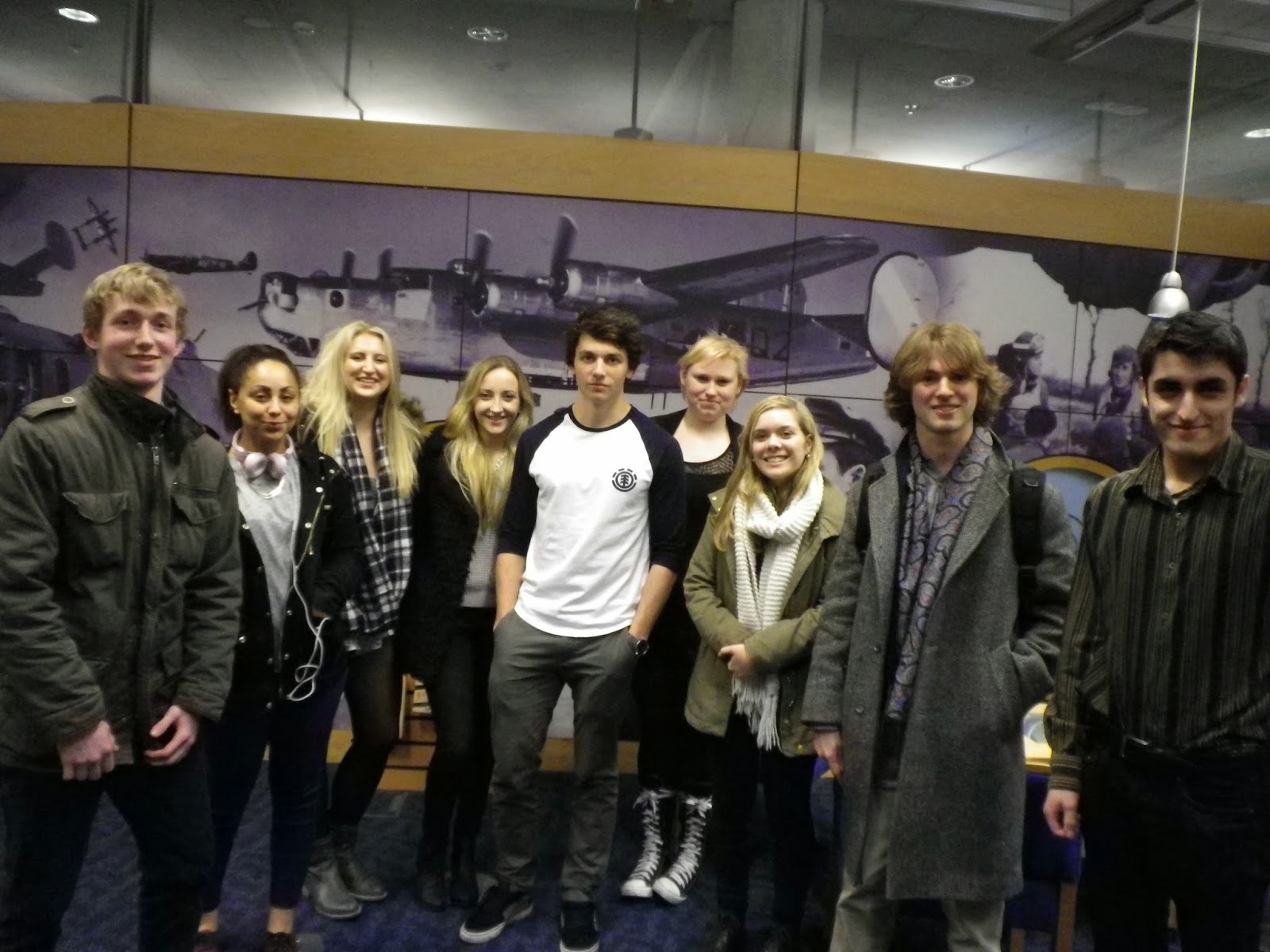
Students from the Containing Multitudes II History module visit the 2nd Air Division Memorial Library


 Containing Multitudes II is an introductory survey module that presents students with the broad outlines of American history from the end of the nineteenth century to the present day. It follows a chronological sequence with weekly topics on the major themes and events in U.S. history since 1890. During their week on the Second World War, the students from the Containing Multitudes module visited the 2nd Air Division Memorial Library in the city centre to explore some of their archival material and secondary sources relating to the Second World War. 


The Memorial Library was built in commemoration of the nearly 20,000 American airmen of the 8th Air Force who served in East Anglia during WWII. As such, the library archive, on deposit with the Norfolk Record Office, has access to personal papers, diaries, photographs, wartime newspapers and magazines, informational pamphlets issued by the U.S. Government and other wartime memorabilia specific to those who served in Norfolk and Suffolk. 

Making use of the library’s primary and secondary sources, the budding historians were able to study, contextualize and analyze the various ways that the war impacted the everyday lives of Americans both at home and abroad. With a multitude of resources at their disposal, each student was left to independently select and research two primary sources of their choice and then present and decode them for the rest of the class.


Focusing on war time ads, posters, art and propaganda, some students examined how support for the war was mobilized and how gender, race and national identity was written, coded and read into many of these wartime ads. Stepping away from national wartime rhetoric others chose to reflect on the ways in which the war affected specific individuals. Appropriately, these students focused on eyewitness accounts, letters from soldiers to their families, diaries and memoirs. Still, others were keen to research the way the war affected specific communities, like women, children and people of color. Finally, some were more interested in the specific experience of the Americans serving in Norfolk and the local communities that received them. 


Having examined material that was produced by the American citizenry and U.S. government during the period of study, the students were offered a unique perspective into the individual, domestic and international consequences of the Second World War. Additionally, the students gained an important opportunity to put their organizational and analytical skills to the test by assessing the primary sources from that period. By the end, the two seminar groups, through their research, presentation and discussion had gained a wider understanding of what life may have been like during the Second World War.


With a lending collection of over 4,000 books, the Memorial Library can offer American Studies students a wide selection of historical and contemporary resources on American life, media, politics and culture. It also offers an alternative study space to the UEA campus that is centrally located within the city centre at the Forum. If you’re interested in learning more and keeping up to date with library events, you can follow their blog, like the facebook page or visit their website at:


**Containing Multitudes seminar leader, Becky Avila, who currently serves as the UEA American Scholar for the 2nd Air Division Memorial Library, organized the field trip.

Monday, 6 January 2014

Emma Long: Corporations Can Speak... But Can They Also Be Religious?


A few weeks ago, UEA's Emma Long published a piece on the History News Network on corporate citizenship, 'Obamacare' and the Supreme Court. Here it is in its entirety in re-blogged form:


On November 25, 2013 the U.S. Supreme Court announced that it would hear argument in a pair of cases which have the potential to be among the most wide-ranging and controversial cases of the Court’s current term. For a docket that already includes affirmative action, public prayer, and campaign finance, that is quite an achievement. But Sebelius v. Hobby Lobby Stores and Conestoga Wood Specialties v. Sebelius involve Obamacare, religious liberty, reproductive health, and questions about the extent of the rights of corporations. These two cases thus encompass some of the most controversial issues in U.S. politics.

These two cases are representative of more than sixty lawsuits filed across the United States which challenge the section of the Patient Protection and Affordable Care Act, more often referred to as Obamacare, which requires companies with more than fifty employees to provide those employees with a minimum level of healthcare coverage, including access to certain types of contraception and pregnancy-related healthcare. After long and heated negotiations, churches and religious non-profit organisations were exempted from this part of Obamacare on religious grounds. The companies involved in these lawsuits, including Hobby Lobby which owns a chain of arts and crafts stores across the U.S. and Conestoga Wood Specialties which makes wooden cabinets, argue that they too should be exempt from this law on the grounds of religious freedom. The owners of these companies assert that they formed and run their companies along lines dictated by their religious faith; requiring them to pay for healthcare which includes certain kinds of contraception, they argue, violates their fundamentally held beliefs as embodied in these companies and thus impermissibly and unconstitutionally burdens their right to the free exercise of their religion.

The Obama administration has argued in return that these are businesses, not individuals of faith nor religious organisations, and thus are not eligible for exemption.

Viewed simply on religious freedom grounds, it seems unlikely that this case would win the majority of the Court. Historically the Court has held that facially neutral laws (i.e. those that do not differentiate on the grounds of faith) which incidentally impact on the religious beliefs or practices of individuals or groups are acceptable. The healthcare mandate does not define its application by religion and therefore appears to fit easily into the Court’s precedents.
In addition, a finding in favour of the company runs the risk of entangling courts across the country in an area that the Supreme Court has consistently denied the judiciary has any role in.

Traditionally the Court has steered clear of making decisions in which it has to decide what can or should be classed as faith or religious belief (for example, disputes between divided congregations or questions of ministerial duty). The danger should the Court find in favour of Hobby Lobby and Conestoga Wood Specialties is that courts and governments around the U.S. will find themselves having to address the question: is this company “religious”? Or, even more dangerously for religious freedom, is this company religious enough? Given that the Court has been reluctant to involve itself in such questions, it seems unlikely that a majority would be willing to hand that responsibility over to lower courts or other branches of government.

However, the great unanswered question surrounding this case comes in the form of the Court’s controversial 2010 ruling in Citizens United v. Federal Election Commission. There the Court, with a 5 to 4 majority, held that corporations, in the form of spending in political campaigns, could “speak” and thus had free speech rights that were protected by the First Amendment. Exactly how far this ruling goes has yet to be challenged. But, if companies can speak, then maybe, just maybe, they can hold and express religious beliefs too. If a majority of the justices are willing to view the cases in this light then the companies might prevail.

Support for this approach is provided by the 1993 Religious Freedom Restoration Act, a federal law that states the government cannot impose a “substantial burden on a person’s exercise of religion,” unless there is “a compelling governmental interest.” A burden incidental to a facially-neutral law may be held to violate the Constitution unless the government can prove that the law fulfils such a compelling interest. Universal health coverage for all would, at least for supporters of Obamacare, meet such a test; critics, of course, argue otherwise.

The Supreme Court’s decision to take these cases is not surprising. The lower courts, the Tenth Circuit for Hobby Lobby and the Third Circuit for Conestoga, divided on the results and reasoning in these cases. In the former, the Tenth Circuit found in favour of Hobby Lobby, holding that the company was a person under RFRA and that there was no compelling interest to justify the burden on its religious beliefs represented by the healthcare mandate. The Third Circuit, however, ruled that secular, for-profit organisations like Conestoga Wood Specialties cannot engage in religious exercise and ruled against the company. Since historically division among the lower courts has been an indicator of likely Supreme Court involvement, commentators had been anticipating that this issue would eventually make its way to the Court’s docket.

What might be the potential consequences of the Court’s ruling? A decision rejecting the companies’ request for exemption from the healthcare mandate would, in effect, put an end to the lawsuits currently being heard across the U.S. and require those companies covered by the Act to provide healthcare including contraception and pregnancy-related healthcare to their employees. Potentially it would also recognise limits to the rights of companies that were expressed in Citizens United. And it would also provide a boost to the fortunes of the beleaguered Patient Protection and Affordable Care Act. According to the companies and their supporters, such a ruling would also impose heavy burdens on the rights of religious freedom for those of faith who choose to run their businesses with a religious ethos.

Should the Court rule in favour of the companies’ claims, at the very least Obamacare would take a significant knock, potentially encouraging further challenges. In addition, the rights and status of corporations and businesses would be expanded significantly beyond their current position: if companies can speak and be religious, what other protections embodied in the Bill of Rights might then be claimed? For many women, the consequence could be making a choice of employment based on the type of healthcare provided, or giving up the right to choose certain contraception methods in favour of employment with one of these companies, a choice not to be taken lightly in the current financial circumstances.

There is, therefore, a great deal at stake in Sebelius v. Hobby Lobby Stores and Conestoga Wood Specialties v. Sebelius. Those with an interest in religious freedom, privacy and reproductive rights, the status of corporations, and, of course, the Patient Protection and Affordable Care Act will undoubtedly be watching with interest.


Tuesday, 19 November 2013

At the Mouth of the Mississippi: Archives, Histories, 12 Years a Slave


AMS Postgraduate student Nicole Willson blogs about her archival research in Louisiana as well as more contemporary representations of slavery in 12 Years a Slave.

Check out Nicole's blog here and follow her on twitter @NicoleWillson

Hey y’all. I’ve been in Louisiana for a week now, and that week seems to have passed by without me even realising. It has been eye-opening, liberating, and, of course, rewarding – on both a personal and professional level. For most of the time that I’ve been here, at least during the working day, I’ve been poring over manuscripts in the archives. I’ve become a regular and recognizable frequenter of several New Orleans institutions, and I’ve been welcomed and assisted by everyone that I’ve met. It hasn’t all been plain sailing, however. Earlier today, I met with some American graduate students at LSU and together we discussed how intimidating the archives can be. The archival material that I have been looking at has been challenging, and not least because a lot of it is in manuscript form and written in a foreign language (not only French, but an archaic eighteenth-century French). To add to this, some of the manuscripts written in English have been equally, if not more, challenging – to give you an example, I spent about two hours trying to decipher a draft foreword that George Washington Cable wrote for his short story ’Tite Poulette, and had to transcribe it, writing down all of the variations of certain words that I could not quite make out, until I came out with the best possible outcome. What I found was interesting, and (I hope) useful, but it could easily have been two hours wasted.

The headaches of reading minute and foreign manuscript with magnifying glasses were assuaged slightly last Friday, when I met Wayne Philips, who manages the costume collection at the Louisiana State Museum. Wayne showed me a selection of ‘tignons’ – also described in the collection catalogues as ‘bandanas’ and perhaps best understood by us as headscarves – worn by women of color in antebellum America, and one in particular that is thought to have originated in Saint-Domingue (colonial Haiti). I had been looking forward to seeing these artefacts, mainly because I think that the best histories are told through palpable objects, and to see them in the flesh pleased me no end. But unlike the manuscripts that had told me, and given me clues to, a great many things, the tignons harboured secrets that I was not able to penetrate. Other than the short descriptions in the LSM catalogues that indicated the origins of the artefacts and alluded to the (racial) status of their unknown wearers, there was no additional information to help me work out what these items might have signified to the wearer or to wider society. Wayne and I talked for some time about the various possibilities but agreed that we could really only speculate on what these might be. The stories of these objects we can only imagine because the presumed female wearers did not write them down – not to our knowledge, at least.

Today, after one of the better days in the archives, I went to see the highly acclaimed Steve McQueen film, 12 Years a Slave. As you know, earlier this year I went to see Django: Unchained, and wrote a lengthy piece about it here. I have done a lot of thinking about Django, since I first saw it, and agree with my younger brother that it’s not really a slave revenge film – or even a film about slavery, for that matter – it is a white fantasy about the history that we would all like to imagine as having happened, and this fantasy is given ultimate sanction by the white liberator/avenger character King, who, in the end, is martyred. This film, in contrast, was an adaptation of the personal narrative of the same name recorded by Solomon Northup, a black musician from the state of New York who was beguiled, captured, and sold into slavery in Louisiana. The film is not unproblematic, and some of the problems surrounding the adaptation had been brought to my attention earlier in the day when the graduate students that I had met with discussed it in their class on the American plantation, but I came out of the cinema with a sense that an important history had been imaginatively brought to life, without (m)any speculative of the fantasies that make films like Django much more problematic. There were holes and silences where those silences exist in reality; I was troubled and saddened, for example, by the fact that the narrative was unable to communicate the fates of enslaved women such as Elizabeth and Patsy, and still feel haunted by the thought of what may have lay in wait for them beyond Northup’s narrative.

Just before the film started, I saw a trailer for the film Belle,which tells the story of a woman of color who forms the second subject in Johann Zoffany’s portrait of Lady Elizabeth Murray. Dido Elizabeth Belle began life as the daughter of a slave woman from the West Indies and Admiral John Lindsay, and was raised in the household of William Murray, Earl of Mansfield. From the snatches that I saw, this film looks to be more of a romance than the stark and meticulous narrative of Steve McQueen’s 12 Years a Slave, but it offers a window into another history that has seldom reached the level of public understanding: the story of what it was like to occupy a precarious space as a black woman in the household of white aristocrats.
I am glad that black histories from the diaspora are being gradually recuperated in film narratives like 12 Years a Slave and I can’t help but be excited about Belle, in spite of the romantic inflections, and I hope that the projection of modern fantasies about the experiences and sufferings of real people does not replace the excavation of those harder to find histories. There are of course things that we may never know, but that doesn’t mean that we should stop looking.

Monday, 11 November 2013

Research Seminar: Professor Coll Thrush

Professor Coll Thrush and Rebecca Tillett in conversation after his presentation

The American Studies Research seminar this week was delighted to welcome Professor Coll Thrush (University of British Columbia) for a talk entitled "London Entangled: Indigenous Histories at the Heart of Empire". Coll Thrush is in London on a research trip, and is in the midst of developing some very exciting work for his current book project. In the past, scholars have often treated Indigenous and urban histories as though they are mutually exclusive. But for Coll Thrush these two kinds of history are closely interrelated, or, to use his word, entangled. In a history of London framed through the experiences of Indigenous people who travelled there, from territories that became the US, Canada, New Zealand, and Australia, he shows how stories of Inuit captives in the 1570s, Cherokee delegations in the 1760s, Hawaiian royals in the 1820s, as well as the memory of these travelers in present-day communities, all show the complex ways in which London is an important ground of Indigenous history and settler colonialism.

Thursday, 24 October 2013

UEA 50th Anniversary: The Art of Conspiracy


 Discovered amongst the volcanic ash, discarded event programmes and shattered plastic pint glasses that covered campus the morning after the UEA 50th Anniversary celebrations, the following missive outlines the proceedings of the the School of American Studies' 'Art of Conspiracy' event. Or does it?..


To whomever this message reaches,

I have some disconcerting news.  As a contribution to the University of East Anglia’s 50th Anniversary Festival an assortment of departments, schools and faculties were asked to think up and run hands on activities throughout Saturday 28th September.  The School of American Studies’ input was an hour-long workshop entitled ‘The Art of Conspiracy’.  According to an unidentified whistleblower, a few days prior to the affair the organisers/puppet masters met in an unknown location to plan the event in painstaking detail.  We will never know for sure what happened in that meeting, but thanks to the testimony of several dependable experts and eye witnesses present at the workshop we have a clearer idea of what really happened that Saturday.

As people filed into room 1.6 of the Thomas Paine Study Centre, there was a certain tension in the air.  People knew something was going to happen, something important, but no one knew exactly what; all they could say was that they had been attracted by the mystic title and blurb in a programme that had been suspiciously handed to all of them earlier in the day.  Coincidence? I think not.

The deep rumble of chatter disappeared abruptly when Dr. Hilary Emmett introduced the running order of the event.  The experts have told me that everything happened exactly as Dr Emmett said it would – how convenient.

First, MA by Research student Joseph Broadbent gave a brief talk titled ‘The Logic of Conspiracy Theory’.  He proposed that conspiracy theorists do not live up to their stereotype and to illustrate this point he demonstrated that the tools to be a conspiracy theorist are innate within all of us.  For example, he explained how just a few biases we exhibit—such as the availability error, proportionality bias, the post hoc fallacy, pareidolia, confirmation bias, and the backfire effect—make us more disposed to believing conspiracy theories than we would initially have thought.  Mr. Broadbent went on to run a mini-experiment to prove his hypothesis.  By playing a verse of Led Zeppelin’s ‘Stairway to Heaven’ forwards, then backwards he managed to get the room to see how the song has been seen by some conspiracy theorists to be a part of a grand satanic plot.  Ending on that note, he left a list of how to build your own conspiracy theory up for the room to see.


Following this the audience, which had already been suspiciously sat in groups of five to eight, were invited to create their own conspiracy theories.  A chosen member from each group went to the front of the room and underwent a ritual, at the end of which they had selected three cards—a person, a corporation, and an event—that had to explain the oncoming zombie apocalypse.

 An eyewitness found this all incredibly troubling because we all know that the zombie apocalypse is going be here soon.  That the number 3 was used is more worrying because we know that it is the only divisor of the number of the beast that gives us the date of this oncoming catastrophe (2/2/22), but the team from American Studies carried on despite these objections.  It is quite clear that the academics from the school of American Studies knew far more about this event than they were letting on because the selection of three cards cannot be a coincidence.  Therefore, I shall name them so that all who deal with them in the future know about their role in this episode; they were: Dr Nicholas Grant, Dr Wendy McMahon, Dr Kaeten Mistry, and Dr Jonathan Mitchell.


After some clearly biased speculation and conjecture each group presented their findings which were rated by how complex and how believable they were.  These ranged from Bill Gates using Microsoft to create wirelessly updateable zombies, to Disney having already started creating mindless zombies (from Britney Spears to Miley Cyrus).  From Sarah Palin being a secret communist, to McDonalds being the epicentre of the future breakout.  On reflection, these entries leave us much to ponder as it is quite possible that they could be truthful, but cloaked in parody so as to disguise their truthiness from the sheeple.

So, we are left with several perplexing questions: first, was ‘the event’ a success? From the information I have to hand I think that for American Studies it would have appeared so, yes, as participants and lecturers alike were seen leaving happily discussing the art of the conspiracy theory.  And, secondly, lastly, and by far the most important, is Miley Cyrus a zombie?  Only time will tell.

Regards,

A. Nonymous.