Thursday, 13 March 2014

Year Abroad Blog: Kitty Mackay, Temple University


In the second installment of blog posts from our current Year Abroad students, Kitty Mackay writes about her experiences at Temple University in Philadelphia. This is definitely a must read for any students hoping to use their year abroad to travel extensively...
 

On the way to the airport I was questioning everything:
Have I forgotten something? Will I make friends? Will the work be difficult? Have I got my passport? Will I miss my dog?!

It was pretty similar to my journey to UEA for the first time, a bundle of nerves and excitement.

The answer to all these questions is, of course, everything will be fine. And my year abroad is (as everybody said it would be,) the best thing I have done in my life so far. My university placement is at Temple University, Philadelphia and, alongside my studies I have also travelled to Washington DC, New York, Toronto, New Jersey and Chicago, since August. I have been given opportunities I never thought I would have experienced before, to name a couple - attending New York Fashion Week and watching Hillary Clinton talk in a Greenbuild convention. I have met people from all over the world and made lifelong friends and, I have survived infamous, crazy, American traditions such as Homecoming and Spring Break.

I set off on my travels having never visited the USA before, and expecting the lifestyle and culture to be pretty similar to that of England, and Temple University to not differ dramatically from UEA. These assumptions could not be further from the truth. The American college system is extremely different to that which I was used to. Temple has 38,000 students, over double the number which attend UEA and the campus is spread across the North of Philadelphia. These buildings are marked with huge red and white ‘T’ flags, the beginning of the phenomenal craze they call ‘school spirit.’ I soon discovered that your university becomes part of your identity, once you are enrolled at the age of 17+. The school emblem is something you wear proudly on your clothes, cars, mugs, folders and even pets accessories(!) and the football team, (in Temple’s case – The Owls) are the team which you support for the rest of your life, no matter how badly they may lose. On my second day in America I witnessed a parent spending $500 on kitting their student out with Temple merchandise, ‘school spirit’ was one of the first differences I noticed between American and English universities. I am in no way saying this is a negative thing, I have embraced it as a kind of novelty since being here, and I am not afraid to say I enjoy sporting my bright red Temple t-shirt and cheering at football matches along with the masses…


 I mentioned the other cities and states which I have visited in my year so far and seeing as much of the country as possible was a big must for me, despite being on a budget. I believe that the financial side of things really puts people off choosing to study abroad, and normally, when people ask about my time here, the first question they ask is – ‘how do you afford it?!’ The tuition is the same and living costs are fairly similar, the extra money you need is for your flights and accommodation which is, on most campuses, outrageously expensive. However, with a little help from Mum and Dad (thanks guys!) and my student loan, it was manageable. Also, if you consider this a once in a life time experience, it is well worth every penny. I managed to travel because I looked for the cheapest ways to: getting the Megabus for 16 hours instead of a 2 hour flight, hitching rides from friends, staying in hostels etc. Although not the most luxurious trips they were definitely adventures, and I would not cross out travelling on your year abroad due to lack of finances.


All this said, the best thing about my year in Philadelphia so far has been the independence I have gained from it. As soon as I waved goodbye to my family, I was all alone and completely independent and it was up to me to go out and explore. I have learnt skills and gained confidence which will stay with me and help me in the future and as a result I would recommend studying abroad to anybody thinking about it!

Kitty Mackay
Tweet Kitty @kitthenit

Monday, 10 March 2014

Year Abroad Blog: Ainsley Bowmer, University of Western Ontario


In the first of a series of posts from our current Year Abroad students, Ainsley Bowmer blogs about his time at the University of Western Ontario in Canada. A must read for any American Studies students planning to head abroad next academic year...
University College, University of Western Ontario
For my year abroad I decided to take the split year option, which I believed would give me the opportunity to further my travels and see and do as much as possible whilst away for the year. I am currently in my second semester at the University of Hong Kong.

My first semester was spent at the University of Western Ontario in London, Canada.

As a stereotypical Brit I’m going to start by talking about the weather.  To my surprise, Canada does actually get quite hot during the summer. We had temperatures in the 20’s well into October and even had one day hit 35c in September. But when the cold does arrive, it’s brutal and it doesn’t go away. Throughout November and December we had tons of snow and the temperature went as low as -25c. You do have to prepare for just how cold it does get but unlike the U.K, you’ll find that everything keeps running as normal in Canada. The buses are on time and no one slows down to 5mph on the roads. 


Western organizes a week’s worth of orientation activities just for exchange students the week before classes start and the Canadians arrive. My advice would be to go to as many of these as possible as they really do help you to meet the other exchange students from around the world. The official ‘freshers’ is called O-week and was my first experience of how different things were from UEA. O-week at Western is on a ‘dry campus’ basis, which means that none of the events revolve around drinking and they mostly take place during the day. There were a lot of talks on how not to start fires in residence and respecting others. I found that a lot of the material in the talks were basic things that everyone should have known already so going to just one of them should be more than enough. Looking back I probably wouldn’t purchase the O-Week pass again as at $83 it was overpriced for the quality of the events that are offered. A freshman opening ceremony was the highlight but there was nothing else that stuck in the memory. I instead took the opportunity to get to know the other exchange students better and we created our own ‘freshers’ week and went to the various bars and clubs around London.

Western itself is a picturesque campus and whilst it is large, I found my way around quite quickly. The UCC is the main hub of the campus and includes a number of eateries and a Starbucks but the main attraction for me was the fact that there is a cinema! UWO film plays two movies a night for $5 about a month after they have been on general release, so there is always something to do if you are bored one evening.
Whilst there isn’t a club on campus there is a bar called ‘The Spoke’ in the UCC. Every Wednesday a local legend called Rick McGhee preforms various songs to a huge crowd of students. The bar is always packed and it’s always a lot of fun, especially when the crowd sings along.

I lived on campus in London Hall, which is where the vast majority of exchange students stay whilst at Western. I would highly recommend staying in London Hall as even though it is expensive, the rooms are large and living with a mixture of exchange students and Canadians allows you a better opportunity to meet more people. You are put into 3 person suites, you share a kitchen/living space and bathroom but the bedrooms are private. I lived with two Canadians who became good friends of mine during my stay and I ended up knowing pretty much everyone on my floor.


One of the most memorable times I had at Western was a day called Homecoming, which is when various events take place around campus and alumni return to the school. What actually happens is that pretty much every single student in the city dresses in purple (the school colour) and the vast majority drink throughout the entire day. One of the main off campus student streets is closed by the police for a big party. It was unlike anything I’d ever seen as everyone opens up their houses for people to come in and there were at least a few thousand students all in purple on this one street. Whilst drinking is a large part of the day it is not compulsory if you’d rather stay sober. The university had a purple pancake breakfast and other events if anyone didn’t want to join the party. Whilst it is just an excuse for a giant party I really got a sense of how big a part that school spirit has for students at Western. Whilst we do have Derby day at UEA it is nothing at all like Homecoming and it was a welcome change to experience a large scale event with people who were happy and proud of their school.

     
I found Canadians to be in general, amongst the friendliest people I’ve ever met. People will go out of their way to help you and everyone is extremely polite. Also, don’t be surprised if you are gawked at the first time someone realises that you are British, everything you’ve heard about them liking the accent is true, they love it. Whilst I got to know a lot of Canadians during my time at Western my experience would have been entirely different had it not been for the great group of exchange students I got to know and become friends with. Moving to a new school in an entirely different country may seem daunting at first but luckily I got to know people from pretty much my first day. My advice would be to not worry about it and just go out and enjoy yourself. Don’t worry if you don’t click with people straight away because there are an enormous amount of opportunities to meet people whilst you are here.

Perhaps the best thing about studying abroad is the travelling options it presents you with whilst you’re away. I went to New York, Washington, L.A, Vegas and San Francisco before starting my semester. The University organised an exchange student trip to Niagara Falls in the first few weeks which was another good opportunity to get to know everybody. A small group of us spent the weekend in Toronto and I know that other exchange students travelled to places like Ottawa and Montreal. Staying in Canada allowed me to take trips that would have been far too expensive if I was in the U.K. I went to Florida for Christmas (a 50 degree temperature swing in the space of a day) and spent New Year’s in New York City. I saw the ball drop in Times Square with other exchange students, which was something I have always wanted to do. The flights were inexpensive and you can even take an overnight bus to get to NYC from Toronto. 


It’s a cliché but my time at Western really was the best few months of my life. It’s a great school full of friendly people not just from Canada but from all over the world. I made some great friends, saw new places and just generally had a lot of fun. The only bad part was that my time there had to come to an end. I can’t recommend Western and Canada enough if you are planning your year abroad. 

The fall semester Western exchange students

Extra info:
  • Accommodation is expensive ($4000 per semester). If you are short on cash and staying the full year then off campus housing is more affordable.
  • A student bus pass and health insurance are mandatory fees, $430 in total. You WILL use the bus a lot so it is useful to have. The school also runs a free shuttle service from the downtown bars at the weekend back to campus, which saves on taxi fares. I needed to go to the hospital at one point so having health insurance helps too!
  •   The student internet service (Reznet) is $180 per semester.
  •   Meal plan is optional in London Hall. Costs between $1900-$2480 for the year.

Friday, 28 February 2014

“And the Winner is…” Why 12 Years A Slave Deserves to Win Best Picture


AMS's Dr. Becky Fraser on why she thinks that '12 Years A Slave' deserves to triumph in the best picture category at the Academy Awards on Sunday night. 

If this year’s BAFTAS is anything to go by then Steve McQueen’s 12 Years A Slave should walk away with the coveted prize of Best Picture at the Oscars on Sunday night. There are other contenders of course, American Hustle, Dallas Buyers Club, Gravity, and Philomena to name but a few. Yet, the story of Solomon Northup, who lived as a free coloured man in New York, subsequent to his kidnapping and sale in the slave market of New Orleans, raises troubling and awkward questions about the American past that this film demands answers to.
McQueen’s retelling of Solomon’s story is a brutally honest and beautifully tragic depiction of the lives of enslaved people in the American South. The small number of Hollywood films which have previously attempted to depict American slavery have either raised historian’s ire because of the historical inaccuracies and lack of authenticity or else have skirted around the vicious realities of the system in favour of representing white male heroes who launch a one-man campaign in the name of abolition. What McQueen does in this film is breathtakingly honest in terms of the historical truths it tells and the faithfulness it retains to Northup’s original narrative.

The film pulls no punches with sadistic violence from almost the very outset. Yet, this, in reality, was what many (if not all) enslaved people experienced and witnessed on the plantations, farms, urban and industrial environments in which they lived. The true horrors of slavery are laid bare for the viewing audience to witness and voice long after the film credits have rolled. Indeed, this is one of the most important aspects of McQueen’s film. The power of the film however lies not just in McQueen’s skilful retelling of its narrative, but in the narrative itself. Once Solomon escaped the torment of slavery through eventually getting word to his white acquaintances in the North who confirm his identity as a free men, he leaves the slave south and returns to his family. This could have been the end of it. An experience never retold. Yet, Solomon actively bears witness to his experiences through his narrative published in 1853. Campaigning on behalf of those still enslaved on North American shores, in order that the crimes he witnessed and indeed experienced himself – the severe whippings, brutal rapes, gratuitous violence, and psychological anguish – were given voice by one who was able.

While the violent realities of the film are immediate, I was also incredibly struck by my emotional response to the film. As an historian of American slavery, with a particular focus on the experiences of the enslaved, and having read countless slave narratives over the years, I credited myself with being able to distance myself from Hollywood depictions of the ‘peculiar institution’. Yet the poignancy of the scenes in the film where the startling and shocking are narrated as the mundane and everyday left me weeping: the deadness of the slaves’ eyes, waiting in the New Orleans’ auction house, as Solomon passes them in the steam ship, the trading of marketable human property as prospective buyers examine Black bodies; the enslaved parents parted from their children, husbands separated from wives, networks of kinship decimated as families were torn apart; and the struggle – often in vain- to retain a sense of self amid the inhumanity of the system.

 Many are used to understanding American slavery as a relationship between the oppressed and the oppressor: the master/slave dialectic where the southern master is always the epitome of evilness and the slave, the pitiful victim. 12 years A Slave rightly challenges this one-dimensional image by exposing the complexities of this slave system and revealing the ways in which various historical actors managed their relationship to that regime. For example, the viewer sees two extremes of mastery with Ford (played by Benedict Cumberbatch) as the more benign, almost reluctant, slaveholder who seems to view his slave labour force as something more than human chattel, placed in contrast to Edwin Epps (played brilliantly by Michael Fassbender) the almost caricatured vicious and malignant master who indulges his violent and perverse pleasures on his enslaved workforce, most particularly Patsey. Furthermore, Mistress Epps (Edwin’s wife, played by Sarah Paulson) is viewed by the audiences as being complicit with the slave system, wholly aware that her wealth depends on it. Mistress Epps’ violent punishments on Patsey, who is subject to Epps’ nightly sexual abuses, is both horrifically raw and yet somehow strangely normalised. Northerners and the northern states too play their part in Solomon’s narrative: he is invited from New York to D.C with the probable original intention of kidnap. Yet he also owes his eventual redemption to residents of the state of New York. 

 
 The enslaved too are represented with active agency of sorts, although many will beg to differ with me on this point. Although no insurrections are mounted nor attempted or actual murders of their masters are plotted, (so no outright “resistance” is achieved) enslaved peoples are depicted as at least attempting to retain a sense of dignity and personhood beyond that of “slave”. Examples of this are fewer in the film but are at least evident. For example, Solomon’s gifts as a violinist and the consolation music afforded him and others; the deliberations in the slave quarters over the rights and wrongs of masters and their ultimate purposes in owning slaves; and Solomon penning his own pass as many enslaved people would do if they had somehow learned to read and write. When reflecting on the experiences of the enslaved under the pernicious rules of Southern racial slavery, it’s particularly important to broaden our concept of what resistance is, moving away from a grand gesture of political overhaul towards acts of everyday survival that enabled the enslaved to at least live under the harshest of adversity. This is, in part, what McQueen does so well.

One might ponder why it was Solomon’s narrative that made it to the screen – why, for example not the more famed Black abolitionist Frederick Douglass, formerly enslaved in Maryland; or the story of Harriet Jacobs, enslaved in Edenton, North Carolina, where she escaped the brutality of her master’s sexual advances, feigning escape by hiding in her grandmother’s attic for seven years. Yet, the fundamental importance of this story is without doubt – it was made with hope perhaps that in future years audiences will hear the voices of other enslaved peoples, their experiences too being retold on the big screen.

McQueen’s film ultimately makes the fundamental point that 12 Years A Slave is not just a story about slavery or the American South; rather it is an American story that needs and demands to be heard by all. Let’s hope the credit it so surely deserves is awarded on Sunday evening.

Thursday, 27 February 2014

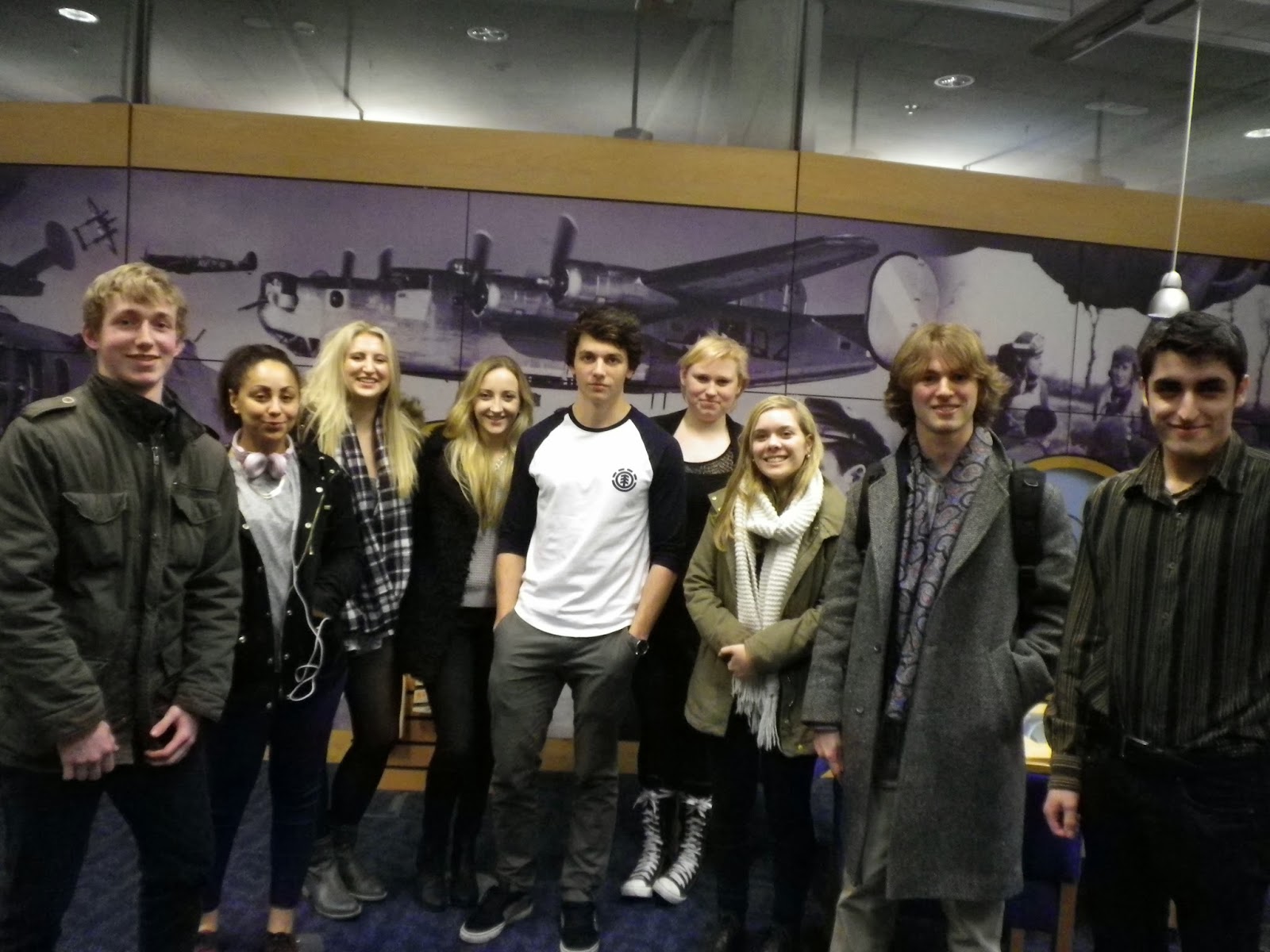
Students from the Containing Multitudes II History module visit the 2nd Air Division Memorial Library


 Containing Multitudes II is an introductory survey module that presents students with the broad outlines of American history from the end of the nineteenth century to the present day. It follows a chronological sequence with weekly topics on the major themes and events in U.S. history since 1890. During their week on the Second World War, the students from the Containing Multitudes module visited the 2nd Air Division Memorial Library in the city centre to explore some of their archival material and secondary sources relating to the Second World War. 


The Memorial Library was built in commemoration of the nearly 20,000 American airmen of the 8th Air Force who served in East Anglia during WWII. As such, the library archive, on deposit with the Norfolk Record Office, has access to personal papers, diaries, photographs, wartime newspapers and magazines, informational pamphlets issued by the U.S. Government and other wartime memorabilia specific to those who served in Norfolk and Suffolk. 

Making use of the library’s primary and secondary sources, the budding historians were able to study, contextualize and analyze the various ways that the war impacted the everyday lives of Americans both at home and abroad. With a multitude of resources at their disposal, each student was left to independently select and research two primary sources of their choice and then present and decode them for the rest of the class.


Focusing on war time ads, posters, art and propaganda, some students examined how support for the war was mobilized and how gender, race and national identity was written, coded and read into many of these wartime ads. Stepping away from national wartime rhetoric others chose to reflect on the ways in which the war affected specific individuals. Appropriately, these students focused on eyewitness accounts, letters from soldiers to their families, diaries and memoirs. Still, others were keen to research the way the war affected specific communities, like women, children and people of color. Finally, some were more interested in the specific experience of the Americans serving in Norfolk and the local communities that received them. 


Having examined material that was produced by the American citizenry and U.S. government during the period of study, the students were offered a unique perspective into the individual, domestic and international consequences of the Second World War. Additionally, the students gained an important opportunity to put their organizational and analytical skills to the test by assessing the primary sources from that period. By the end, the two seminar groups, through their research, presentation and discussion had gained a wider understanding of what life may have been like during the Second World War.


With a lending collection of over 4,000 books, the Memorial Library can offer American Studies students a wide selection of historical and contemporary resources on American life, media, politics and culture. It also offers an alternative study space to the UEA campus that is centrally located within the city centre at the Forum. If you’re interested in learning more and keeping up to date with library events, you can follow their blog, like the facebook page or visit their website at:


**Containing Multitudes seminar leader, Becky Avila, who currently serves as the UEA American Scholar for the 2nd Air Division Memorial Library, organized the field trip.

Monday, 6 January 2014

Emma Long: Corporations Can Speak... But Can They Also Be Religious?


A few weeks ago, UEA's Emma Long published a piece on the History News Network on corporate citizenship, 'Obamacare' and the Supreme Court. Here it is in its entirety in re-blogged form:


On November 25, 2013 the U.S. Supreme Court announced that it would hear argument in a pair of cases which have the potential to be among the most wide-ranging and controversial cases of the Court’s current term. For a docket that already includes affirmative action, public prayer, and campaign finance, that is quite an achievement. But Sebelius v. Hobby Lobby Stores and Conestoga Wood Specialties v. Sebelius involve Obamacare, religious liberty, reproductive health, and questions about the extent of the rights of corporations. These two cases thus encompass some of the most controversial issues in U.S. politics.

These two cases are representative of more than sixty lawsuits filed across the United States which challenge the section of the Patient Protection and Affordable Care Act, more often referred to as Obamacare, which requires companies with more than fifty employees to provide those employees with a minimum level of healthcare coverage, including access to certain types of contraception and pregnancy-related healthcare. After long and heated negotiations, churches and religious non-profit organisations were exempted from this part of Obamacare on religious grounds. The companies involved in these lawsuits, including Hobby Lobby which owns a chain of arts and crafts stores across the U.S. and Conestoga Wood Specialties which makes wooden cabinets, argue that they too should be exempt from this law on the grounds of religious freedom. The owners of these companies assert that they formed and run their companies along lines dictated by their religious faith; requiring them to pay for healthcare which includes certain kinds of contraception, they argue, violates their fundamentally held beliefs as embodied in these companies and thus impermissibly and unconstitutionally burdens their right to the free exercise of their religion.

The Obama administration has argued in return that these are businesses, not individuals of faith nor religious organisations, and thus are not eligible for exemption.

Viewed simply on religious freedom grounds, it seems unlikely that this case would win the majority of the Court. Historically the Court has held that facially neutral laws (i.e. those that do not differentiate on the grounds of faith) which incidentally impact on the religious beliefs or practices of individuals or groups are acceptable. The healthcare mandate does not define its application by religion and therefore appears to fit easily into the Court’s precedents.
In addition, a finding in favour of the company runs the risk of entangling courts across the country in an area that the Supreme Court has consistently denied the judiciary has any role in.

Traditionally the Court has steered clear of making decisions in which it has to decide what can or should be classed as faith or religious belief (for example, disputes between divided congregations or questions of ministerial duty). The danger should the Court find in favour of Hobby Lobby and Conestoga Wood Specialties is that courts and governments around the U.S. will find themselves having to address the question: is this company “religious”? Or, even more dangerously for religious freedom, is this company religious enough? Given that the Court has been reluctant to involve itself in such questions, it seems unlikely that a majority would be willing to hand that responsibility over to lower courts or other branches of government.

However, the great unanswered question surrounding this case comes in the form of the Court’s controversial 2010 ruling in Citizens United v. Federal Election Commission. There the Court, with a 5 to 4 majority, held that corporations, in the form of spending in political campaigns, could “speak” and thus had free speech rights that were protected by the First Amendment. Exactly how far this ruling goes has yet to be challenged. But, if companies can speak, then maybe, just maybe, they can hold and express religious beliefs too. If a majority of the justices are willing to view the cases in this light then the companies might prevail.

Support for this approach is provided by the 1993 Religious Freedom Restoration Act, a federal law that states the government cannot impose a “substantial burden on a person’s exercise of religion,” unless there is “a compelling governmental interest.” A burden incidental to a facially-neutral law may be held to violate the Constitution unless the government can prove that the law fulfils such a compelling interest. Universal health coverage for all would, at least for supporters of Obamacare, meet such a test; critics, of course, argue otherwise.

The Supreme Court’s decision to take these cases is not surprising. The lower courts, the Tenth Circuit for Hobby Lobby and the Third Circuit for Conestoga, divided on the results and reasoning in these cases. In the former, the Tenth Circuit found in favour of Hobby Lobby, holding that the company was a person under RFRA and that there was no compelling interest to justify the burden on its religious beliefs represented by the healthcare mandate. The Third Circuit, however, ruled that secular, for-profit organisations like Conestoga Wood Specialties cannot engage in religious exercise and ruled against the company. Since historically division among the lower courts has been an indicator of likely Supreme Court involvement, commentators had been anticipating that this issue would eventually make its way to the Court’s docket.

What might be the potential consequences of the Court’s ruling? A decision rejecting the companies’ request for exemption from the healthcare mandate would, in effect, put an end to the lawsuits currently being heard across the U.S. and require those companies covered by the Act to provide healthcare including contraception and pregnancy-related healthcare to their employees. Potentially it would also recognise limits to the rights of companies that were expressed in Citizens United. And it would also provide a boost to the fortunes of the beleaguered Patient Protection and Affordable Care Act. According to the companies and their supporters, such a ruling would also impose heavy burdens on the rights of religious freedom for those of faith who choose to run their businesses with a religious ethos.

Should the Court rule in favour of the companies’ claims, at the very least Obamacare would take a significant knock, potentially encouraging further challenges. In addition, the rights and status of corporations and businesses would be expanded significantly beyond their current position: if companies can speak and be religious, what other protections embodied in the Bill of Rights might then be claimed? For many women, the consequence could be making a choice of employment based on the type of healthcare provided, or giving up the right to choose certain contraception methods in favour of employment with one of these companies, a choice not to be taken lightly in the current financial circumstances.

There is, therefore, a great deal at stake in Sebelius v. Hobby Lobby Stores and Conestoga Wood Specialties v. Sebelius. Those with an interest in religious freedom, privacy and reproductive rights, the status of corporations, and, of course, the Patient Protection and Affordable Care Act will undoubtedly be watching with interest.